
Program IV · Gorilla
Gorilla Archives · Guided Safaris® Research Lab
Dian FosseyGorilla Fund
Since 1967 the same research record has followed the Mountain Gorillas of the Virungas, from a camp between two volcanoes to the Ellen DeGeneres Campus.
Plan of the exhibition
You are here
The entrance hall
Scroll to walk the route, or choose a room.
For a guided walkthrough only, not the actual layout of the rooms.
The Ellen DeGeneres Campus · Kinigi, Rwanda
An exhibition in eight rooms
Dian Fossey’s work, and everything it set in motion: her fieldwork on the volcanoes, a gallery with a re-created cabin, the science that carries on at the Ellen DeGeneres Campus and the people who lead it today.
Program
Dian Fossey Gorilla Fund
Since 1978
Dian Fossey formed the Digit Fund in 1978 to support anti-poaching patrols. Today’s Dian Fossey Gorilla Fund still runs the Karisoke Research Center she founded, and protects and studies Mountain Gorillas in Rwanda.
Plan of the exhibition
You are here
The entrance hall
Scroll to walk the route, or choose a room.
For a guided walkthrough only, not the actual layout of the rooms.
Room 1 of 8
Ellen campus
The Fund’s work has had three homes: a camp on the saddle between two volcanoes, a building in the town of Musanze and the Ellen DeGeneres Campus in Kinigi, built in 2022.
The camp on the mountain
Dian Fossey founded the Karisoke Research Center on September 24, 1967, and named it for the two volcanoes it stood between, Karisimbi and Bisoke. Porters carried supplies up to the isolated camp, where tents came before cabins.
The exhibit in Musanze
In 2016 the research center opened the Karisoke Exhibit in its building in Musanze, with photographs, films, historical objects and interactive activities for visitors and local communities. The New Times of Rwanda pictured the Senior Advisor for the Gorilla Program, Veronica Vecellio, showing guests through a room given over to Dian Fossey.
The campus
The Fund calls the Ellen DeGeneres Campus the realization of a 20-year dream: its first permanent, purpose-built home. In February 2018 Portia de Rossi announced the Ellen Fund as a 60th-birthday gift for Ellen DeGeneres, with the campus as its first project. MASS Design Group designed the buildings, taking a cue from Fossey’s first tent: footprints that follow the slope, green roofs that blend into the land and gathering spaces that echo the camp’s fires. More than 2,400 Rwandans worked on the project.
The campus opened to the public on February 1, 2022, and was dedicated that June. Three main buildings carry their donors’ names: the Sandy and Harold Price Research Center, the Rob and Melani Walton Education Center and the Cindy Broder Conservation Gallery.
1.1
Gorilla museum opens in Musanze
December 10, 2016
The New Times report on the Karisoke Exhibit, created by the Karisoke Research Center and run by the Fund.
1.2
Gorilla Journal
March 2017
The Fund’s own journal looks back on the exhibit’s opening year in the Karisoke building in Musanze.
1.3
The Ellen DeGeneres Campus
Kinigi, Musanze District · Opened February 1, 2022
The stone dug out for the foundations went back into the buildings as grout, gravel and cladding.
Artist’s impression of the campus, for concept only.
1.4
Karisoke
Founded September 24, 1967
The center’s name joins Karisimbi and Bisoke, the volcanoes on either side of the first camp.
Room 2 of 8
The Field Notes
Dian Fossey’s importance is clearest in the work itself: repeated observations of known animals, painstaking records and the effort to make Gorillas visible as social individuals. The Fund’s trackers still follow the descendants of the families she first came to know.
From a first visit to Karisoke
Fossey first traveled to Africa in 1963 and returned in December 1966. Louis Leakey encouraged the project, and Sanwekwe, an experienced tracker, helped her early work in Congo before insecurity forced the move to Rwanda. After poachers killed the silverback Digit at the end of 1977, she formed the Digit Fund to support anti-poaching patrols. Gorillas in the Mist followed in 1983.
What she observed
Her own October 1971 article in National Geographic acknowledges George Schaller’s earlier study and explains her aim of watching animals without provoking flight. The article follows named groups and individuals rather than a generic Gorilla. Fossey describes learning quiet, feeding-associated calls from two young orphans she nursed, Coco and Pucker, taking recordings to Cambridge, where she earned a doctorate, and mapping how group ranges changed.
Pen, paper and nose prints
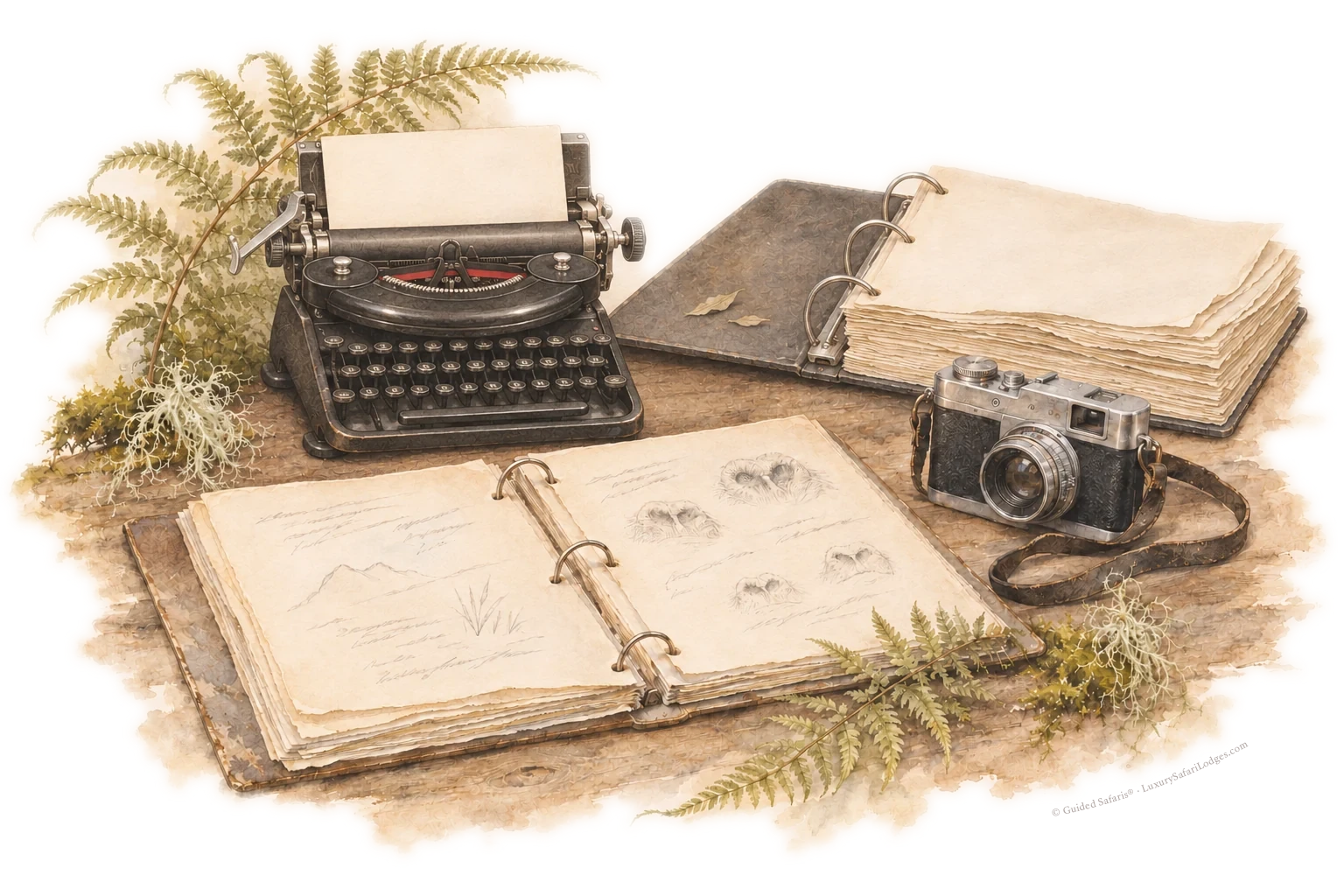
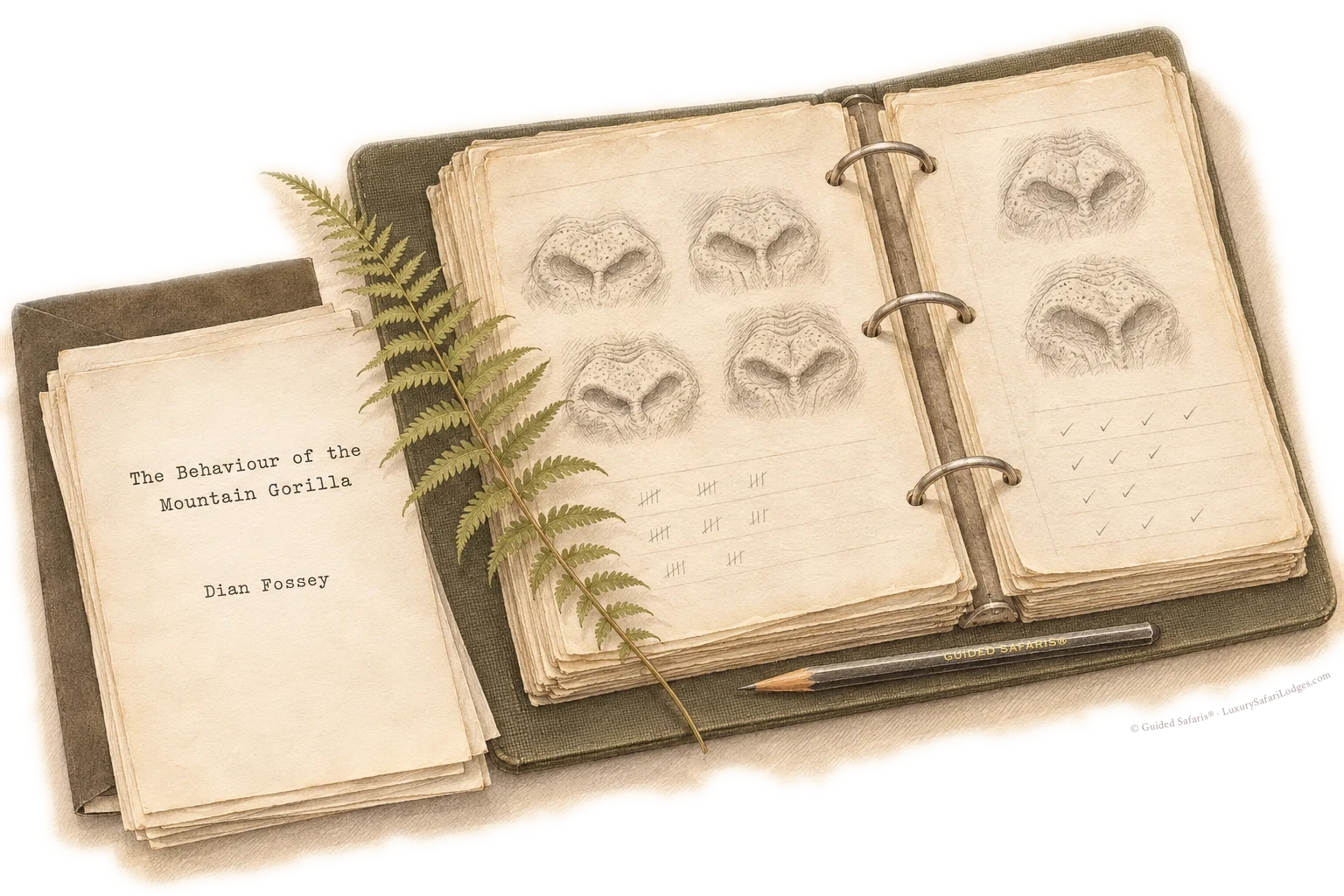
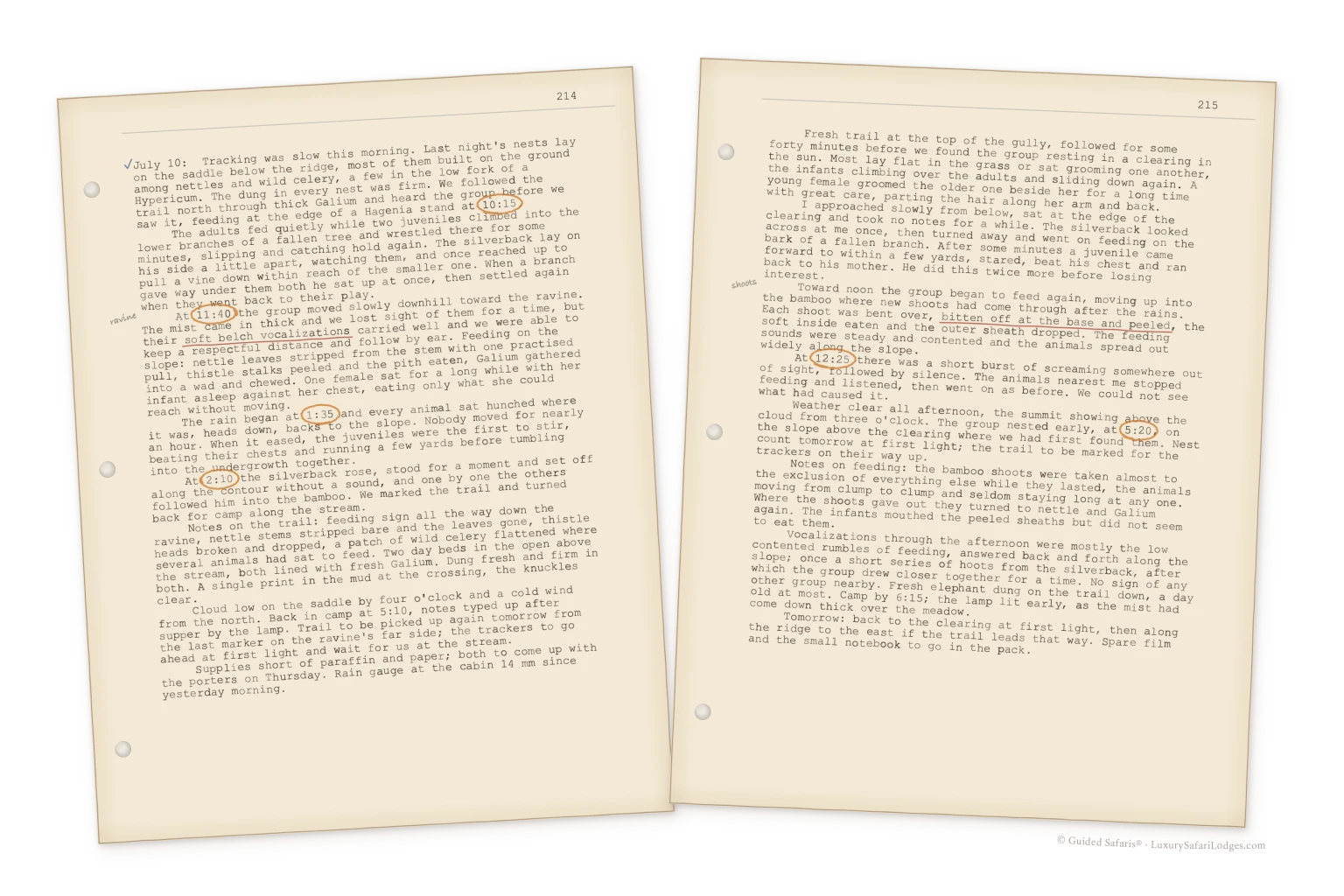
Fossey worked with pen and paper, a manual typewriter and a camera, drawing maps, sketching each Gorilla’s nose print to tell individuals apart and typing up her field notes each night for her loose-leaf notebooks. The Fund calls those notebooks the beginning of one of the longest-running databases on any wild animal.
- 1963First journey to Africa
- 1966Returns to Africa, December
- 1967Founds Karisoke, September 24
- 1969Nurses the orphaned infants Coco and Pucker
- 1971“More Years With Mountain Gorillas,” National Geographic, October
- 1973Lectures to the National Geographic Society, November 16
- 1978Forms the Digit Fund
- 1979Recruits Jonas Nubaha to her anti-poaching team
- 1983Publishes Gorillas in the Mist
- 1985Laid to rest at Karisoke among the Gorillas, December
2.1
A working life, dated
1963–1985
Dian Fossey’s years in the Virungas.
2.2
A manual typewriter
A study
The field notes were typed up each night, whatever the day on the mountain had been.
2.3
Nose prints
A study, after the field practice
Every Gorilla’s nose carries its own pattern of creases. A sketch of each one let an observer tell individuals apart in the field.
2.4
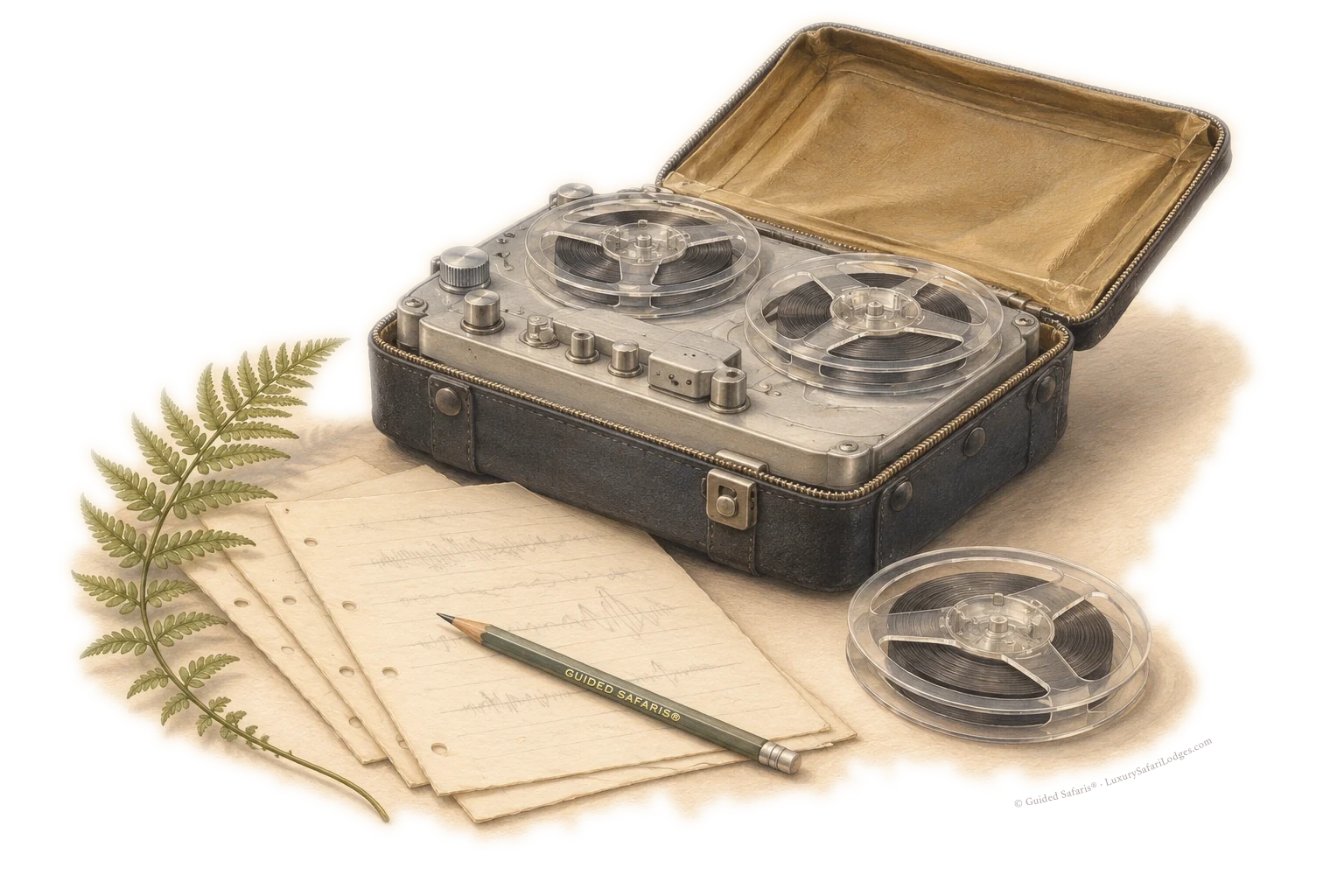
The Mountain Gorilla
Lecture, November 16, 1973
Fossey’s lecture to the National Geographic Society, in a transcript corrected by the University of Florida. At 23:13 she talks about returning to wild observations after the infants went to a zoo, using what she had learned about their sounds.
Room 3 of 8
Living research
The Cindy Broder Conservation Gallery joins memorial material to the story of living research. Its strongest moments connect a recognizable object to a scientific practice.
Three chapters
The designers, MASS, describe an exhibition that moves through Dian’s World, Gorillas and You and Modern Conservation. Scrims and photographs evoke the cabin, and interactive displays lead toward the people doing conservation now.
The cabin
The exhibit fabricator formula D_ describes a reconstruction of Fossey’s cabin, with a re-created projection system and some of her original furniture and belongings. Her passport and wristwatch lie in a timeline exhibit.
A skeleton at the dedication
At the dedication in June 2022, Tara Stoinski, the Fund’s President and CEO, showed visitors the skeleton of the silverback Cantsbee.
Digital Gorillas
Leonardo DiCaprio named the 360-degree theater for his mother, Irmelin. Habitat XR’s launch release of June 2022 names two films for it: A Day in the Life of Gorillas, produced with the Fund and following Gasizi in Pablo’s group, and Saving Mountain Gorillas: The Dian Fossey Legacy, from the National Geographic Society’s Impact Media Lab with Habitat XR. Virtual-reality kiosks and GorillAR, an augmented-reality trail led by a computer-generated silverback, carry the story out into the garden.
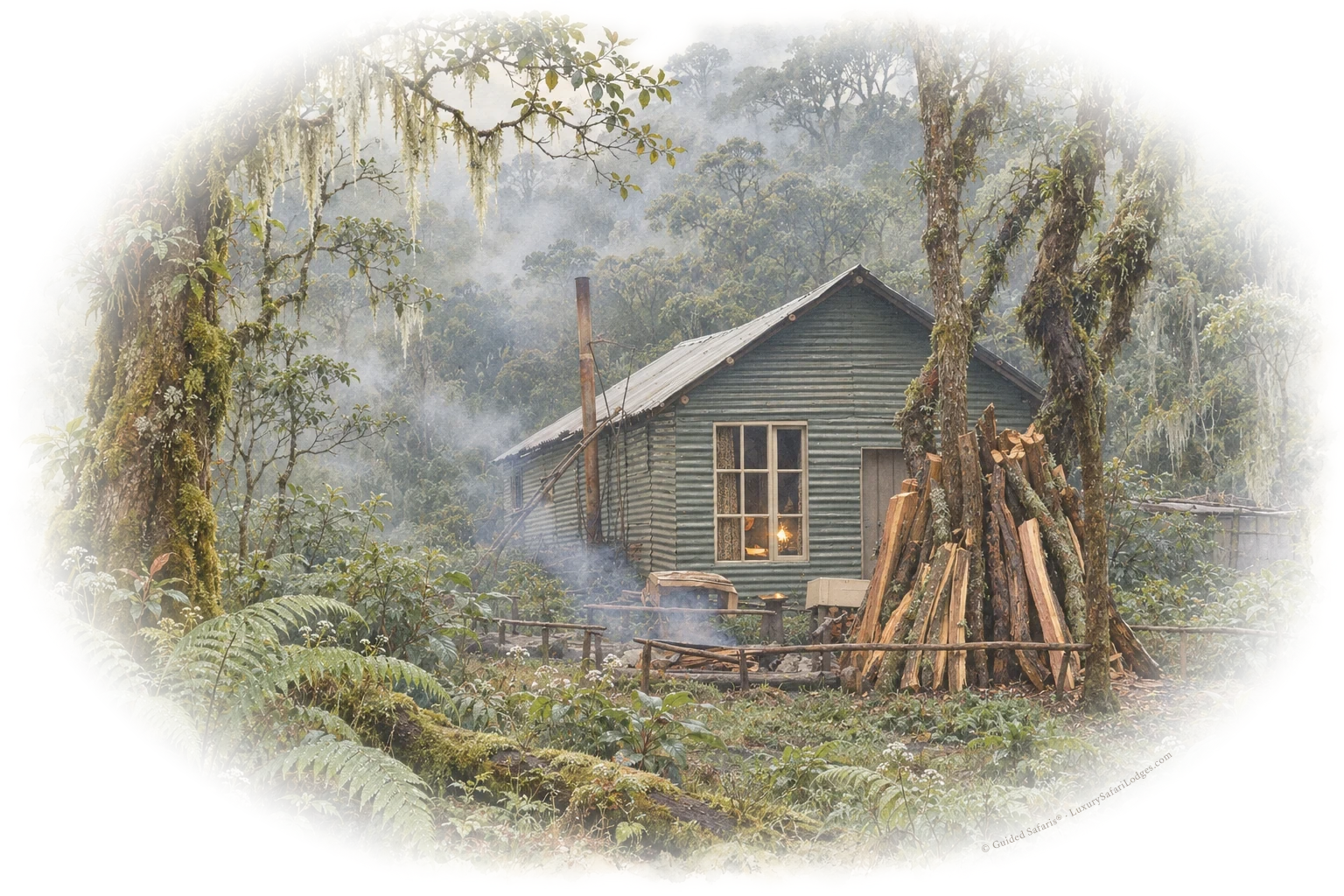
3.1
Re-created cabin with original objects
Cindy Broder Conservation Gallery, opened 2022
A reconstruction of Fossey’s cabin with a re-created projection system. Scrims and photographs evoke the walls.
Artist’s impression of the cabin, for concept only.
3.2
Cantsbee’s skeleton
Shown at the campus dedication, June 7, 2022
Part of what the Fund calls the largest collection of Mountain Gorilla skeletons in the world. Our drawing lays out bones as a study tray.
Now Playing
3.3
The Irmelin DiCaprio Theater
Launched June 15, 2022
Wild Gorillas in the round, a few miles from the forest they live in.
Room 4 of 8
Older than the building
Karisoke is both a historical name and a continuing research program. The campus is the program’s home, not its starting date, and it makes more sense once you know what the Fund keeps doing outside the gallery.
Why a long record matters
Elizabeth Williamson and Katie Fawcett’s research history explains the method: habituated Gorillas can be recognized, photographed, given nose-print records and followed through births, transfers and deaths. Because the same groups have been followed across generations, the Fund holds what it calls one of the most complete multigenerational family histories of any wild mammal. The Fund’s researchers have followed one maternal line through five generations, from a female Fossey first saw in 1967 to an infant born in 2024.
Some findings show only across decades. A 2025 study of two decades of records followed 56 females through 152 moves between groups and found that they prefer groups holding females they once lived with: old friends, kept across years apart. Tara Stoinski, a co-author, has said that a few years and a few groups would never have shown those ties at all.
4.1
Nearly 60 years of daily records
1967 to today
Each mark on the rule is a year of observations at Karisoke, from typed notes to smart devices. Karisoke turns 60 on September 24, 2027.
4.2
First analyses on site
2023
The Fund’s hormone laboratory ran its first analyses in 2023, after decades of exporting samples. Lab coordinator Marie Rose Umuhoza, a Rwandan biotechnology graduate, trains students in its techniques.
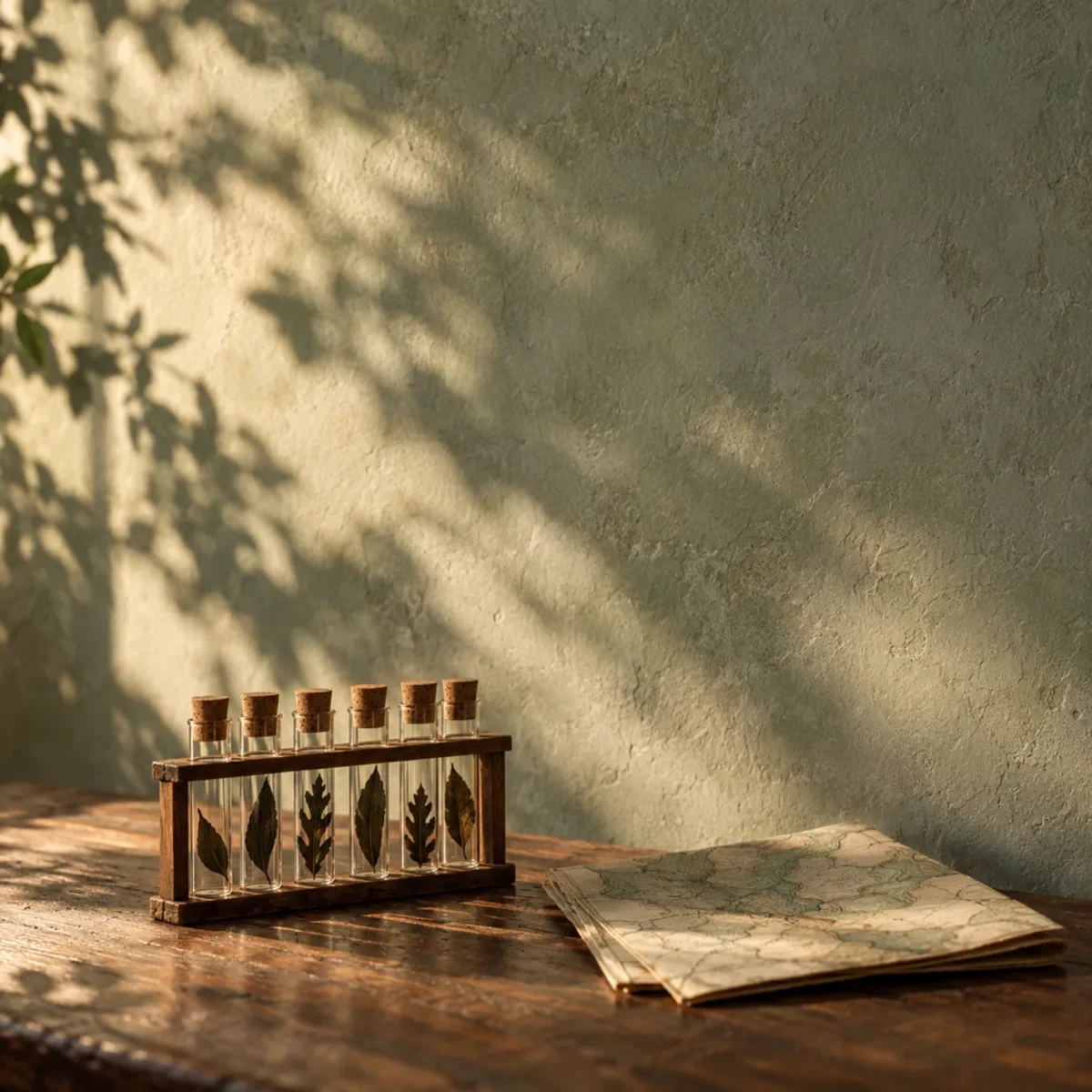
4.3
What Gorillas eat
A study
Honorine Ihimbazwe, who joined the Fund as a research assistant, led its 2025 study of diets across 12 groups and most of the park.
Science in a new place
The campus brought the laboratory home. MASS says the Price Research Center expanded the Fund’s lab capacity fivefold, and in 2026 the Bruce R. Tolchin Genetics Laboratory joined the hormone lab, so that DNA from Gorillas and other species no longer has to be analyzed elsewhere. In the field, parallel lasers now measure Gorillas’ growth without anyone touching them, and data that once went into notebooks goes into smart devices.
Room 5 of 8
The team
A person-centered story need not be a one-person story. The record names Rwandan scientific leaders, trackers and educators, and a tracker whose expertise crossed borders.
Leadership and field continuity
In January 2012, Felix Ndagijimana became Karisoke’s first Rwandan director, after joining as a research assistant in 2004 and earning a master’s in primate conservation at Oxford Brookes in 2008. Ndagijimana now directs all of the Fund’s Rwanda programs.
Jonas Nubaha offers another kind of continuity. Fossey recruited him for her anti-poaching team in 1979, and he tracked Gorillas for four decades before retiring in 2019. His son, Marcel Habumugisha, became a Fund tracker in 2022.
A tracker whose work crossed borders
The University of Florida’s Bob Campbell exhibit identifies Sanwekwe as a tracker who worked with George Schaller in 1959, helped Fossey learn tracking and behavior and later worked at Karisoke. Fossey credited him with enabling her first Gorilla photographs, at Kabara in 1963.
From student to scientist
Deogratias Tuyisingize began as an intern in 2004 and became, the Fund says, the first Rwandan Ph.D. on its staff. James Munyawera met the Fund through its field courses as a University of Rwanda student, worked as a research assistant, won a fellowship at the University of Oxford and is now pursuing a Ph.D. at the University of Oregon on the Mountain Gorilla gut microbiome.
- SanwekweTracker. With George Schaller, 1959; with Fossey at Kabara, 1963; later at Karisoke
- Jonas NubahaTracker. Recruited by Fossey, 1979; retired, 2019
- Marcel HabumugishaTracker since 2022
- Felix NdagijimanaResearch assistant, 2004. Karisoke’s first Rwandan director, January 2012
- Veronica VecellioWith the Fund in Rwanda since 2005. Gorilla Program Senior Advisor
- Deogratias TuyisingizeIntern, 2004. Biodiversity Research Program Manager
- Samedi MucyoResearch assistant, 2011. Gorilla Program Manager
- Marie Rose UmuhozaLab Coordinator, the hormone laboratory
5.1
Names, with their dates
1959–2026
People in the Karisoke record, each with the role and years the Fund or a library gives them.
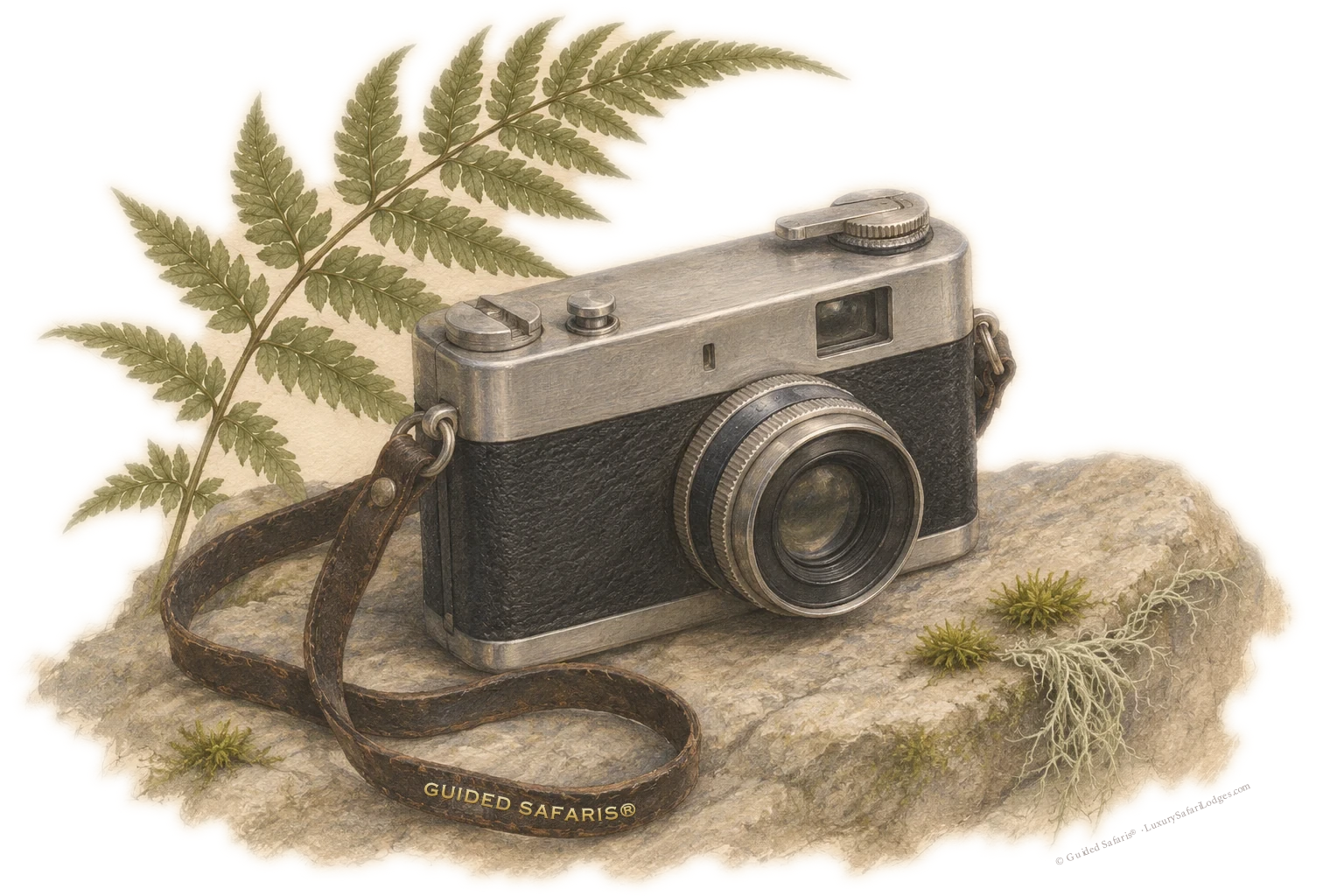
5.2
A camera at Kabara
1963
Fossey credited Sanwekwe with her first Gorilla photographs. Our drawing is a 35 mm camera of the period.
Room 6 of 8
The next generation
Creating conservationists is one of the Fund’s four pillars, and the campus is its home: the laboratories, the classrooms and a landscape built to be studied.
A thesis on the mountain
The Fund has hosted University of Rwanda students for senior thesis research since 2003. The Memoirs Program, run with the university, the Rwanda Development Board and Cleveland Metroparks Zoo, gives 10 to 12 top undergraduates a year a supervised research project, and a 2020 paper by Fund scientists found 83 percent of its participants working or studying in conservation. In December 2022 the program moved to the campus, where students now live and work on site.
Earlier still
Each August more than 100 students attend a two-week summer conservation camp on the campus, and visiting students record birds and butterflies for the Fund’s biodiversity researchers. Girls in Conservation, launched in 2023 and coordinated by Nadia Niyonizeye, supports girls from communities next to Volcanoes National Park through secondary school with workshops, mentoring and scholarships.
- Protecting GorillasDaily tracking and protection, side by side with the park authorities
- Conducting critical scienceLong-term records of known Gorillas, and the laboratories to read them
- Creating conservationistsUniversity students, early-career scientists and the Fund’s own staff
- Building resilient communitiesSchools, clubs and projects chosen by the families around the park
6.1
Four pillars
The Fund’s plan for 2025–2030
The Fund’s work rests on four pillars, under the motto “Helping People. Saving Gorillas.”
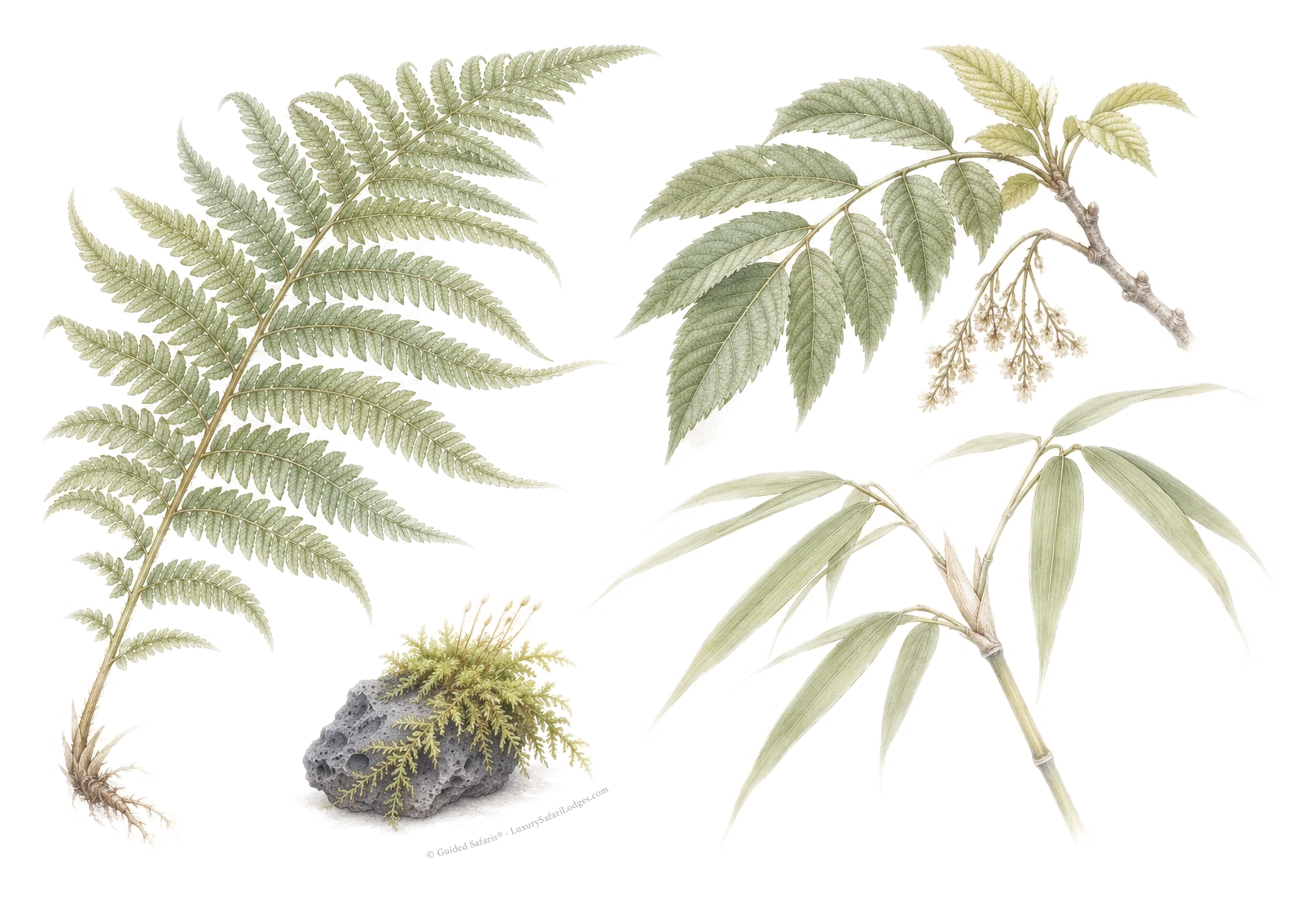
6.2
A living laboratory
A watercolor study
The grounds hold a planted mosaic of four habitats from the park, with more than 250,000 native plants of 120 species. Researchers test propagation methods in the nursery beside them.
A nursery for the park
MASS and its landscape partner TENxTEN designed the grounds with trails that trace a Gorilla’s daily movements, the park’s vegetation zones and a wetland’s water cycle. The Fund reports that birds, pollinators and other wildlife came back within four years, as its scientists documented with plant monitoring, surveys and acoustic recorders. The seed nursery’s methods will serve the planned expansion of Volcanoes National Park.
Room 7 of 8
Today
The Fund’s teams are in the forest 365 days a year. Trackers follow the same Gorilla groups for years, often for whole careers, in Rwanda’s Volcanoes National Park.
The trackers
The Fund gives daily, full protection to 10 Mountain Gorilla groups in Volcanoes National Park, which it estimates at about half of Rwanda’s Mountain Gorillas, working closely with the Rwanda Development Board. Jean Damascene Hategekimana, known as Fundi, began as a cook at Karisoke and had been with the Fund for 31 years by July 2025; as field operations coordinator he now manages the trackers’ schedules.
The people who kept it going
Writing in 2008, Elizabeth Williamson and Katie Fawcett credited the long-term dedication of Karisoke’s trackers, its anti-poaching patrols and Rwanda’s national parks office with much of the success of the research and with the Gorillas’ continued survival. Those are the people who carried the record through the hardest years of the country’s history.
7.1
Typed field notes
Karisoke, from 1967
Loose-leaf notes typed up each night. Today’s field staff record the same observations on smart devices and upload them to central databases.
7.2
The Karisoke records
Nearly 60 years
Winnie Eckardt, the Fund’s Senior Manager of Primate Research, joined as a research assistant in 2004 and now looks after the database built over that time.
Room 8 of 8
Information desk
The Fund, its campus and its work, in brief.
Information
The campus
The Ellen DeGeneres Campus of the Dian Fossey Gorilla Fund
- Where
- Kinigi, Musanze District, Rwanda, a few miles from Volcanoes National Park
- Opened
- February 1, 2022; dedicated June 7, 2022
- Design
- MASS Design Group; landscape with TENxTEN
- Inside
- Laboratories, classrooms, a library, the gallery, the 360-degree theater and housing for students and visiting researchers
- Recognition
- COTE Top Ten award, American Institute of Architects, 2024
The Fund
The Dian Fossey Gorilla Fund
- Founded
- By Dian Fossey in 1978, as the Digit Fund
- Home
- Atlanta, on the grounds of Zoo Atlanta since 1995; the Ellen DeGeneres Campus in Rwanda
- Leads
- Tara Stoinski, Ph.D., President and CEO and Chief Scientific Officer
- In Rwanda
- Felix Ndagijimana, Country Director and Director of the Karisoke Research Center
- Honorary Chair
- Sigourney Weaver
The work
Mountain Gorillas in Rwanda
- Rwanda
- Mountain Gorilla, Volcanoes National Park
- Partners
- Rwanda Development Board, University of Rwanda, Gorilla Doctors, Zoo Atlanta, Cleveland Metroparks Zoo
- In 2026
- Scientific advisor to A Gorilla Story: Told by David Attenborough, on Netflix
- Ahead
- Karisoke turns 60 on September 24, 2027
Travel with the workSignature Guided Safaris® Journeys
Bisate Lodge
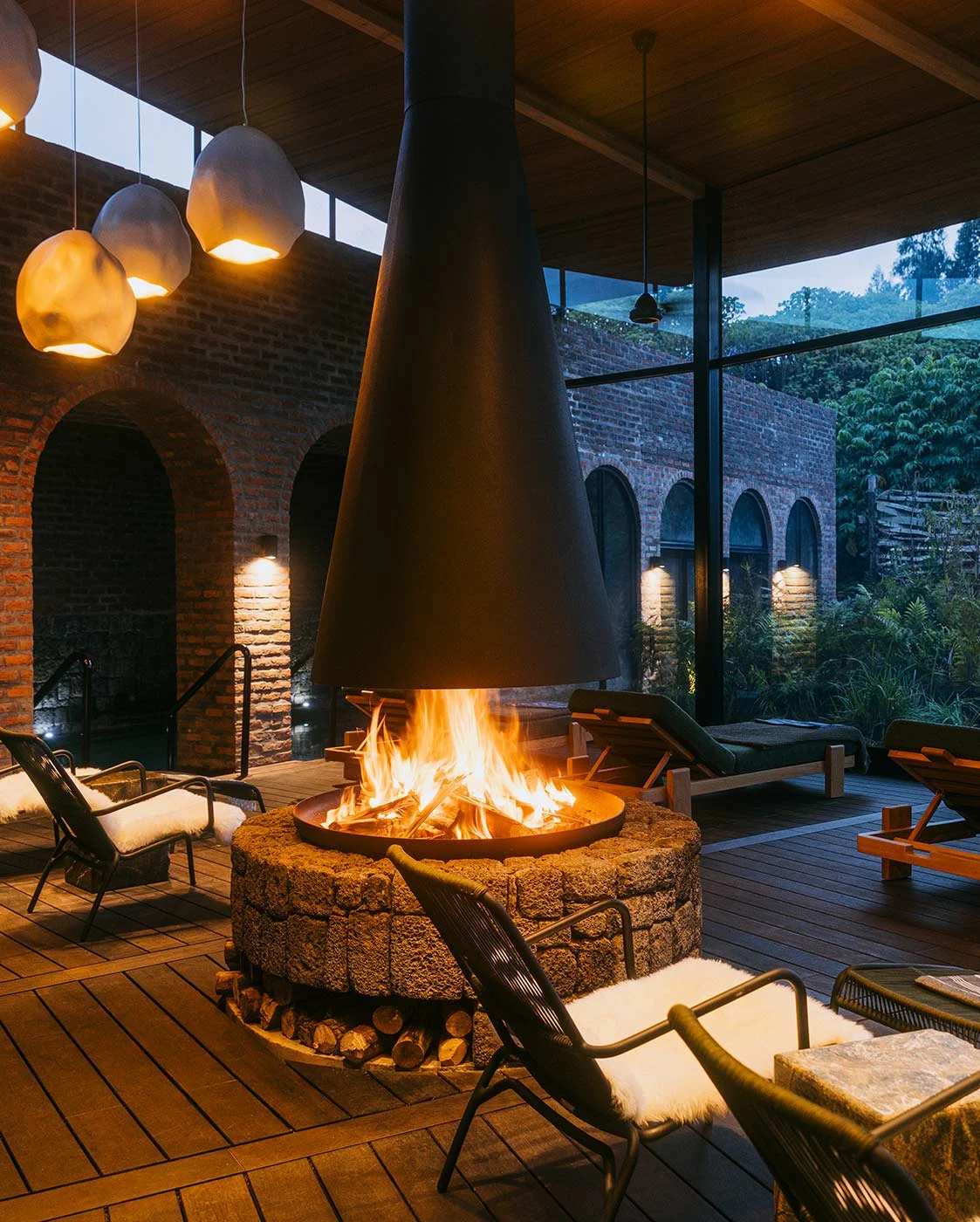
Rwanda’s finest lodge, with six suites in the natural amphitheater of a volcanic cone and wraparound views of the Virungas.
The lodge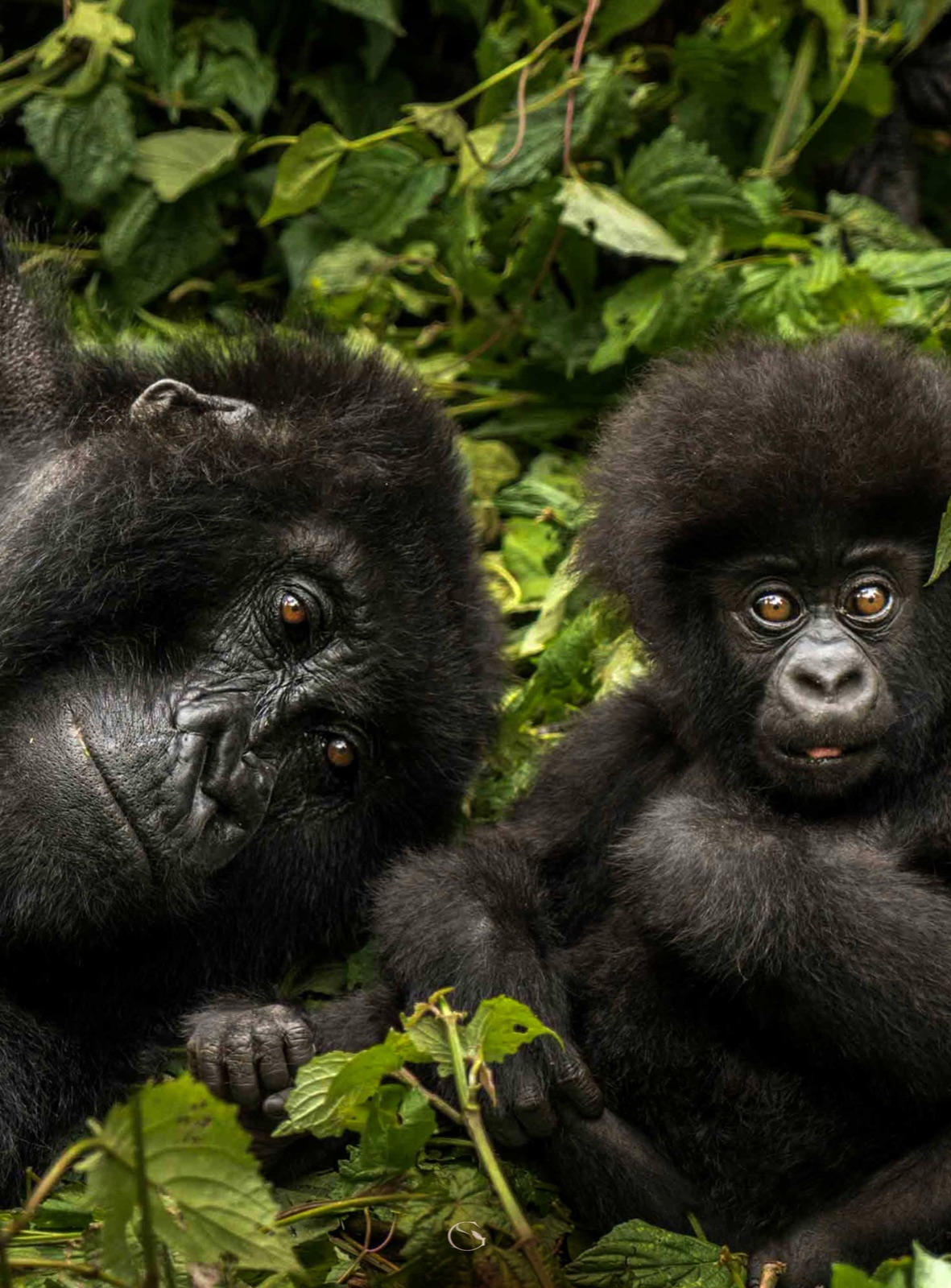
Private Gorilla Safari
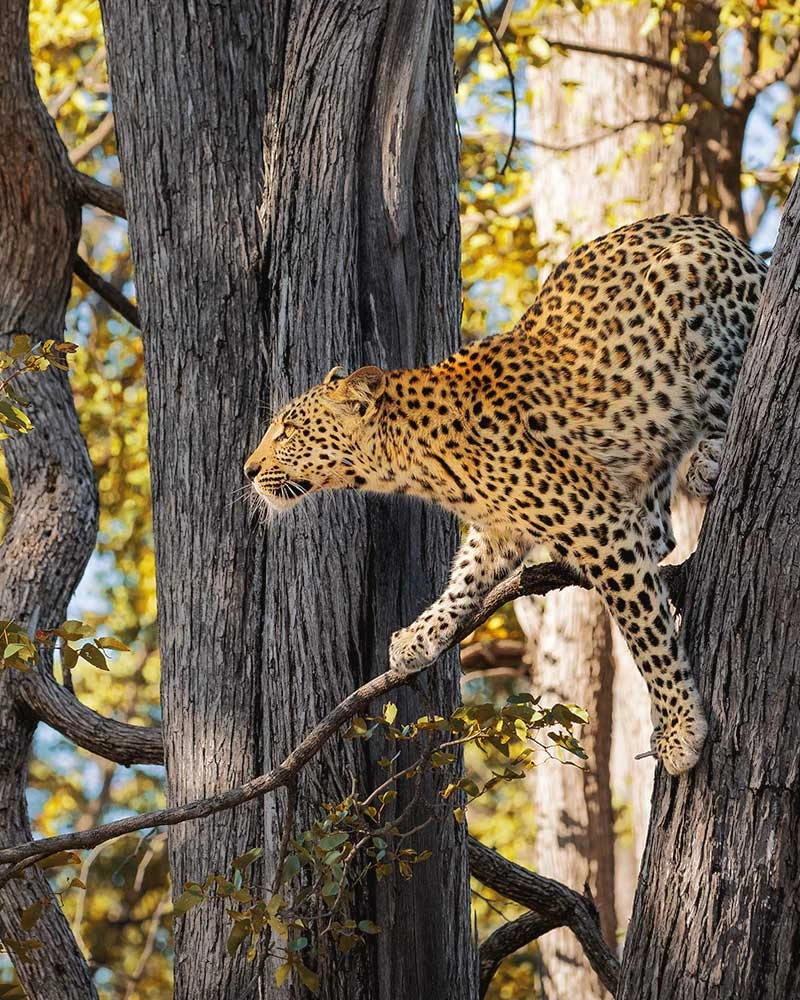
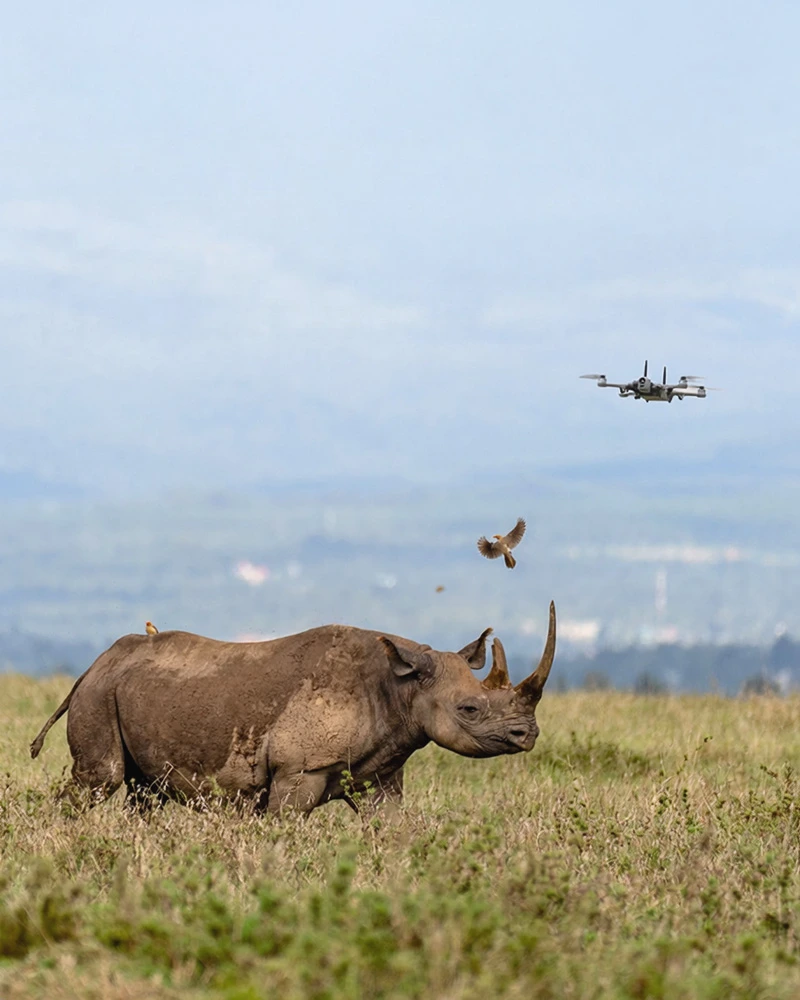
From the Gorillas of Rwanda’s Volcanoes National Park to the Big Cats of the Masai Mara, on one private journey.
View journeyThe partnersOn the ground
- Dian Fossey Gorilla FundRwanda
- Rwanda Development BoardRwanda
- Gorilla DoctorsRwanda
- University of RwandaRwanda
- Cleveland Metroparks ZooMemoirs Program
- Zoo AtlantaAtlanta
- MASS Design GroupThe campus
Working with travel partners and conservation projects in the field, the Guided Safaris® research lab teams share new ideas from across Africa that highlight key conservation efforts on ground. Staying in close contact throughout this supplier chain ensures that the whole network shares a responsible and innovative approach.
Next · Program V
Marine Life
The Bazaruto Center for Scientific Studies records Mozambique’s Bazaruto seascape around the clock, home to Southern Africa’s main remaining Dugongs.
Enter the program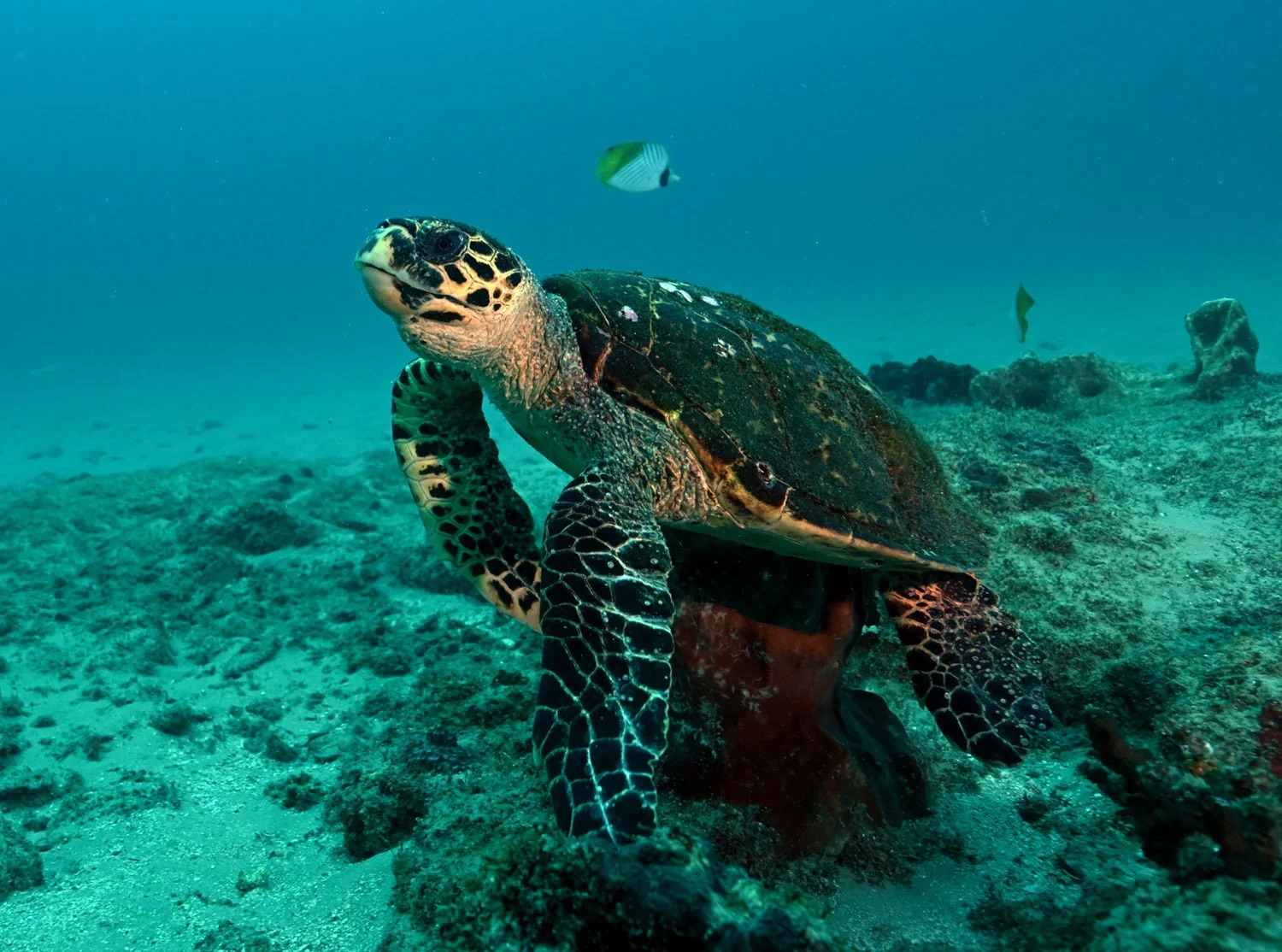
A Living Thread
Conservation at the heart of every journey
Over 30 years in Private African journeys.
Supporting key conservation initiatives across sub-Saharan Africa, Guided Safaris® journeys feature the continent’s finest private game reserves and award-winning eco-luxury camps and lodges that safeguard endangered wildlife through low-impact, sustainable travel.
We are honored to share our stories, safari craftsmanship and commitment to the African wilderness with you.
Discover Signature Journeys